Physics 20083 - Complete Study Guide

(1)
Be able to define wavelength, frequency and photon. Given the relationship between frequency, speed and wavelength (the wave equation) and the relationship between photon energy and wavelength, be able to identify regions of long and short wavelength, regions of high and low frequency, and regions of high and low photon energy on a spectrum (a graph of intensity vs wavelength).

(2)
As an object heats up, two things happen to the continuous radiation it emits: First, the overall intensity of radiation increases. Second, the peak wavelength of the radiation gets shorter. Explain qualitatively why both of these occur. Given a continuous radiation spectrum for an object of a certain temperature, be able to sketch the spectrum of an object that is slightly warmer or cooler based on these principles.

(3)
How do we use the information from question 2 to estimate the temperatures of stars? Why do objects appear more red, then more yellow, then more blue as they get hotter?

(4)
Use a graph of continuous radiation to explain why it is easier to see the photons emitted by the human body in the infrared region of the spectrum as opposed to the visible region of the spectrum.

(5)
Explain why atoms can only absorb or emit certain, specific photon energies (wavelengths). Explain what happens when an atom absorbs or emits a photon.

(6)
Given a simplified energy level diagram, be able to tell which energies can (or cannot) be absorbed/emitted by an electron in the atom in question.

(7)
Explain how we use the principles of atomic emission and absorption to deduce the composition of clouds of gas, stars, etc.

(8)
Be able to draw an intensity vs wavelength graph of a typical continuous spectrum, an emission line spectrum and an absorption line spectrum. Understand the relationship between graphical spectra (plots of intensity vs wavelength) and pictures of spectra (like the three spectral pictures in figure 5-14 on page 115 of the text).

(9)
Under what conditions do we see emission line spectra? Under what conditions to we see absorption line spectra? Describe exactly how an absorption line spectrum is generated.

(10)
Know the two rules associated with Doppler shift (redshift/blueshift and radial velocity proportional to shift) and be able to apply them to real examples of spectra. Know the difference between radial and transverse velocity. If I show you a "rest" spectrum and a couple of other comparison spectra, be able to state whether the comparison objects are moving toward or away from us and which one is moving faster

(11)
Does distance necessarily have anything to do with Doppler shift? In other words, if star A is 100 light years away and star B is 200 light years away (neither star moving relative to us), will the light from one star be shifted relative to the other (and if so, will the light be blueshifted or redshifted)? Explain your answer. (TQ #1)

(12)
What is the photosphere of the Sun? Explain the concept of limb darkening. What does limb darkening tell us about the temperature structure of the Sun's photosphere?

(13)
Suppose the temperature of the photosphere were constant throughout (instead of the current situation in which it is slightly cooler as you look closer to the surface). Would we still experience the limb darkening phenomenon when we look at the Sun? Explain. (TQ #2)

(14)
What is the chromosphere? Why does it cause absorption lines to appear in the Sun's spectrum?

(15)
If we were to observe the Sun's corona during a total solar eclipse (the photosphere is completely blocked by the Moon), what sort of spectrum would we see? (emission, absorption, continuous) Explain.

(16)
Explain the process of ionization. Given a simple energy level diagram (e.g. "E=0,5,7,13"), be able to answer questions like "List the energies that an electron in this atom can absorb from its position in the lowest energy level." Explain why ionization typically only happens to atoms in high temperature environments.

(17)
Define ionization species. Explain how different species of ions are used to estimate the temperature of clouds of gas. How do the ionization species of atoms change as one looks further away from the Sun's surface in the corona? What does this tell us about the temperature structure of the corona?

(18)
Explain why spectral line widths are proportional to the temperature of a gas. How do the spectral emission line widths change as one looks further away from the Sun's surface in the corona? What does this tell us about the temperature structure of the corona?

(19)
Explain why, although coronal gas has a very high temperature in the vicinity of the Earth, the Earth actually absorbs very little heat energy from this gas.

(20)
Explain how the principle of "equipartition of energy" predicts that temperatures in the low-density gas of the corona will be much higher than in the high-density gas of the photosphere/chromosphere. As one looks further away from the surface of the Sun, the temperature of the corona (the average energy of each gas particle) increases. How would you expect the density of gas changes as you look further away from the Sun? Explain.

(21)
State and briefly explain the equation we use to estimate the lifetime of the Sun (based on the total fuel available and the luminosity). Be able to describe a similar example, such as a car ("tank holds 20 gallons, fuel burns at a rate of 4 gallons/hr, how many hours does the fuel last?").

(22)
Explain how gravitational energy can be a heat source for the Sun. Why would the Sun get hot if it were shrinking?

(23)
Explain why chemical and gravitational energy were not accepted as viable methods for energy generation in the Sun's core.

(24)
What is the difference between fission and fusion? Why do Astronomers believe fission is an unlikely energy source for the Sun?

(25)
Explain briefly how fission and fusion reactions generate energy. Where exactly does the energy come from in these reactions?

(26)
Explain why both high temperature and high density are needed in order for fusion reactions to take place. While the Sun's corona has temperatures of millions of degrees, similar to temperatures in the core, no fusion occurs there. Why do you think this is so?

(27)
Based on your reading of Philosophy and the Scientific Method, answer the following: What is the most significant concept that separates scientific and non-scientific theories? The fact that non-scientific ideas can't be disproven means they aren't useful as a basis for a system of knowledge. Why not? What is the problem with relying on irrefutable beliefs? Also, why is relying on refutable (scientific) reasoning so useful? After all, the theory might be wrong. A total of 4-5 sentences should be more than sufficient to answer these questions, if you are concise. (TQ #3)

(28)
What is the "solar neutrino problem"? Despite this inconsistency with theory, most scientists still believe that nuclear fusion is the source of energy for the Sun's core. Explain why this theory hasn't been abandoned, as the scientific method suggests it ideally should.

(29)
Read the following web site detailing the solar neutrino problem (SNP): http://www.maths.qmw.ac.uk/~lms/research/neutrino.html, and summarize the "physical" and "astrophysical" solutions to the SNP in 1-2 sentences each. (TQ #4)

(30)
Based on the above website (there's a link to this information embedded in the text), explain the "Helium-3 Instability" in your own words (3-4 sentences, you don't have detail every single step, just a broad outline) and explain how this might be affecting climate on Earth over time. (TQ #5)

(31)
How is the core of the Sun defined? What is the envelope of the Sun?

(32)
Explain what happens in the radiative zone of the Sun.

(33)
Explain what happens in the convective zone of the Sun. Why is energy transported differently in the convective zone? Why does energy ultimately leave the Sun in the form of light/radiation?

(34)
If we were to increase the core temperature of the Sun by 10-20%, what would happen to the boundary between the radiative and convective zones? Would you expect it to remain in the same general place, move inward or move outward? Explain your answer.

(35)
Read the following website from Scientific American about the concept of "cold fusion" and answer the questions that follow (there are three different essays about this ... it will help give you a good perspective if you read all three): http://www.scientificamerican.com/askexpert/physics/physics6.html. In 2-3 sentences, describe what "cold fusion" is and how it works. There have been dozens of claims since the initial claim by Pons and Flesichmann that experiments have shown "cold fusion" processes are releasing energy from Hydrogen atoms. What are two reasons these claims are not believed by the majority of the scientific community? (TQ #6)

(36)
Explain how to use parallax to determine the distance to a nearby star. Given the parallax equation, be able to answer questions like "For a star at a given distance, if we observe using a longer baseline, explain what will happen to the observed parallax angle. What if the baseline doubles and the star's distance is doubled?"

(37)
Given the parallax equation, be able to draw simple diagrams that justify it. For example, be able to show why the parallax angle should increase as the baseline increases or why the parallax angle should decrease as the distance increases. Also, be able to explain why the parallax method is generally limited to the nearest stars.

(38)
Know the definitions of apparent and absolute luminosity. Given the inverse square law equation, explain briefly how we use it to estimate the distances to stars.

(39)
Describe how you could determine the distance to a star thousands of parsecs away, assuming that star has spectral characteristics identical to our Sun.

(40)
Be able to solve simple proportionality problems with the inverse square law, such as "Star B has an absolute luminosity one-half that of star A, and star B is only one-half the distance of star A. How does the apparent luminosity of star B compare to that of star A?"

(41)
Given the equation of absolute luminosity, be able to solve simple proportionality problems such as "Star B has a Radius (size) twice as large as star A. Star B has a surface temperature one-half that of star A. How does the absolute luminosity of star B compare with that of star A?"

(42)
Given the angular size equation, explain how the angular size technique can work to help us find the size (radius) of a star if we know the angular size and distance to the star.

(43)
Visit the Hipparcos mission web site at http://astro.estec.esa.nl/Hipparcos/ and answer: What was the purpose of the Hipparcos mission? Check out http://astro.estec.esa.nl/Hipparcos/poster.html to help you explain two useful scientific results that came from this mission. 1-2 sentences each.(TQ #7)

(44)
Visit the GAIA mission web site at http://astro.estec.esa.nl/GAIA/Science/Science.html and answer: What is the purpose of the planned GAIA mission? Explain two useful scientific results expected to come from this mission (look on the menu under "Scientific Topics" for details. 1-2 sentences each. (TQ #8)

(45)
Given the equation relation density, mass and size for a star, be able to solve simple proportionalities, such as: "Star B is 4 times more massive than star A. Star B has a radius twice the size of star A. How does the density of star A compare to that of star B?"

(46)
Explain why spectral line widths should depend on the density of a gas (whether a gas cloud or a stellar atmosphere).

(47)
Given two spectral emission lines from two gas clouds of the same temperature and mass, be able to state which one probably has a smaller size based on the line width, and be able to explain your reasoning.

(48)
If a given spectral line is very broad, how can we tell whether that width is due to a high temperature or a high density (or both)?

(49)
Explain the difference between line width and line strength.

(50)
Explain how atoms like Hydrogen tend to have weaker absorption line strengths at very low temperatures and very high temperatures. How do we use this information to estimate the temperatures of stars?

(51)
Be able to put together different concepts regarding stellar properties. For example, "Explain how one could use apparent luminosity, line width and peak wavelength for a given star to estimate the distance to that star." Or "Suppose two stars have the same apparent luminosity and size (radius), but star A has higher ionization species in its spectrum compared to star B. Which one is probably further away? Explain." For more examples, look through old exams.

(52)
Given an H-R diagram, be able to explain how we know stars in the "giant" region really are big, simply by using information about the stars' absolute luminosities and temperatures. Do the same for the "dwarf" region of the diagram.

(53)
Given an H-R diagram, be able to plot roughly the positions of stars based on properties like size, temperature and absolute luminosity. For example, "Star X has 1/2 the surface temperature of the Sun but 20 times the radius. Plot (roughly) where this star would fall on the H-R diagram relative to the Sun's position."

(54)
Imagine a sample of the 1,000 stars with the highest apparent luminosity as seen from the Earth. Why would this sample not be representative of the stars in our galaxy?

(55)
Imagine a sample of the 1,000 stars with the highest surface temperature. Would this sample be representative? Explain.

(56)
Imagine a sample of the 1,000 nearest stars to Earth. Would this sample be representative? Explain. What is the Copernican Principle, and how does it apply here?

(57)
A currently important political topic is the issue of sampling in the 2000 U. S. Census. Should the census be an actual enumeration of people, or should statistically undercounted people be included? In 2-3 sentences each, summarize each side of this position. Several good documents on this issue can be found at http://www.louisville.edu/library/ekstrom/govpubs/goodsources/census/csample.html. (TQ #9)

(58)
When astronomers observe binary star systems edge-on, the spectral line fingerprints of the system sometimes seem to split, then merge, then split, then merge, etc. Explain (with the help of a simple diagram) what is going on in the system that causes this behavior in the spectrum.

(59)
How do we use the spectral line shifts in a binary system to determine the orbital velocity? How does the orbital velocity of the companion relate to the shift of its spectral lines?

(60)
Explain how we determine the period for the orbit of the companion star. Given the equation of orbital velocity and the period equation, explain how we use the period and the spectral line shifts to estimate the mass of the central star in an edge-on binary system.

(61)
Given the two orbit equations, be able to answer simple proportionality questions such as: "Star A and Star B have the same orbital distances to their companion stars, but star A's companion shows large Doppler shifts compared to star B's companion. Which star is probably more massive, star A or star B?" or "Star A and star B have the same mass, but star A's companion shows a smaller Doppler shift compared to star B's companion. Which star's companion is probably at a larger orbital distance, star A's companion or star B's companion?"

(62)
Be able to answer simple proportionality questions having to do with both the period equation and the equation of orbital velocity, such as: "Suppose the companions star A and star B show the same Doppler shifts, but star A's companion has a period twice as long as star B. Which of the two central stars is more massive? Explain or show your work."

(63)
How do we use light curves to help determine whether or not a binary system we are observing is truly being seen edge-on or instead at some inclination angle? What causes the apparent luminosity of an eclipsing binary to change? What would a light curve look like for some Astronomer in another solar system looking at the Sun?

(64)
In a face-on system, why can't we directly measure the orbital velocity of the companion star? How do we estimate the period of a face-on binary system, assuming we can clearly distinguish both stars in the system? Is it necessary to watch an entire orbit? Explain.

(65)
In a face-on system, describe how we use the angular size method to determine the orbital distance. Given the angular size equation, explain what we need to know to find the orbital distance. What are a couple of ways we can find the distance from Earth to the face-on system? How do we combine the period and orbital distance information to determine the mass of the central star?

(66)
Suppose we are assuming that a binary system is being seen edge-on. We measure the maximum Doppler shift and from that estimate the orbital velocity, then we find the orbital distance using the angular size method (as opposed to using the period equation). We use this information to estimate the mass of the central star. Later, another Astronomer double-checks our data, discovering that while our orbital distance measurement is correct, the system is not eclipsing! The fact that this system is tilted away from being edge-on means that our estimate of the mass is incorrect. Is our estimate higher than the true mass or lower than the true mass? (TQ #10)

(67)
What is the difference between the terms "larger" and "more massive"? Are larger stars necessarily more massive? Explain.

(68)
Astronomers have learned that there is a close relationship between the masses and luminosities of typical (main sequence) stars. Explain why we believe this relationship exists.

(69)
Given the mass-luminosity relation, be able to relate this to the method we use for estimating the lifetimes of stars. Use this method to help explain why more massive stars (despite the fact that they have more "fuel" to burn compared to the Sun) live shorter lifetimes.

(70)
This question regards the fictional element "nebulium" that some scientists once thought might be real. This is not discussed in your book, so you'll have to do some research on your own on the web (and I'm not providing links this time...you're on your own). Answer the following questions: What led scientists to think nebulium was a previously unknown element? What is nebulium, and why weren't we able to originally identify it correctly? What are forbidden lines, and why do we not see forbidden lines in typical laboratory spectra while we see them all the time in interstellar gas clouds (and in our upper atmosphere during aurorae). (TQ #11)

(71)
What is the difference between gas and dust? What sort of light does each emit and why?

(72)
The Interstellar Medium (ISM) has two effects on stars, extinction and reddening. Explain why stars appear redder when seen through a cloud of gas and dust.

(73)
Explain why the Sun appears red when near the horizon. Also, explain why the sky is blue. For supporting material in the book, you might want to check out page 352 in chapter 15.

(74)
Suppose we don't take into account the reddening of starlight by the ISM. How will our estimate of the surface temperature of the star differ from the true surface temperature? How will out estimate of the absolute luminosity differ? What about our distance estimate? You may answer either quantiatively (using the equation of absolute luminosity and the inverse square law) or qualitatively.

(75)
Given the modified form of the inverse square law (with the ISM correction term "X" included), explain how we find X. Explaining how we determine the type and number of gas atoms along our line of sight (how and why do ISM spectral fingerprints different from the fingerprints of gas in a stellar atmosphere?).

(76)
Explain two methods we can use to estimate the amount of dust along our line of sight to a nearby star. As part of your answer, explain why we can use infrared light to check for the existence of dust.

(77)
What is pressure equilibrium. Given the pressure equation, explain why the condition of pressure equilibrium leads to the inverse relationship between density and temperature in the ISM.

(78)
What is self-gravity? Given the equation for self-gravity, explain why the self-gravity of a typical molecular cloud (typically thousands of times more massive than a star like our Sun) is so small. Explain how a triggering event (such as a nearby supernova explosion) can change an object's self-gravity, initiating star formation.

(79)
Read the following article about organic molecules in interstellar clouds, http://www.sciam.com/1999/0799issue/0799bernstein.html, then answer the following: How do we know that roughly 30 tons of complex organic molecules are "raining" down into our atmosphere? How do we think these molecules originated in molecular clouds, and what does star formation (and ultraviolet light from new stars) have to do with it? What role might these molecules play in an origin of life scenario? What implications does this research have on the possibility that life might exist elsewhere outside our solar system? (TQ #12)

(80)
During the collapse of a molecular cloud, name and explain what is happening to the self-gravity, the density, the temperature and the outward-pushing pressure of the cloud.

(81)
Why do stars have a minimum mass? In other words, why is it that objects with masses smaller than about 8% of the mass of the Sun never form into stars? What stops the collapse of these objects? What stops the collapse of clouds with masses greater than about 8% of the mass of the Sun?

(82)
Read the following article about Brown Dwarf stars, http://www.sciam.com/2000/0400issue/0400basri.html, then answer the following: What is a brown dwarf? How and why do the spectra of brown dwarfs differ from other stars? What is the brown dwarf desert? Perhaps the solution to the "brown dwarf desert" problem has to do with biased vs representative samples. Explain how previous studies may have been biased against finding brown dwarfs (especially since broad random surveys seem to turn up brown dwarfs just as often as other kinds of low mass stars). (TQ #13)

(83)
During the main sequence lifetime of the star, the density and temperature of the core slowly increase. Explain why each of these two increases occurs and how this affects the absolute luminosity of the star.

(84)
Read the following brief article about the Faint Sun Paradox, http://earthsky.com/2000/es000226.html and then state the basic paradox and how the Earth has "resolved" this paradox through changes in its atmosphere. (TQ #14)

(85)
What is hydrostatic equilibrium (HSE)? Use the principle of HSE to help explain why as the absolute luminosity of the sun's core grows over time that will cause the overall size of the star to increase.

(86)
At the end of the sun's main sequence (Hydrogen-burning) phase, it will have grown to such an enormous size that it will turn red in color instead of its characteristic yellow. Explain why the Sun will change color like this.

(87)
In the Sun's core, Helium fusion will begin eventually but only after the density and temperature reach a much higher value than they needed to for Hydrogen fusion. Explain in detail why Helium fusion requires higher density and higher temperature compared to Hydrogen fusion.

(88)
The Hydrogen-burning phase of the Sun's lifetime will last for about 10 billion years, and the Helium-burning phase will go much faster, lasting for perhaps only about 1 billion years. The same ratio generally holds true for all stars. Use this fact to explain why, in a representative sample of stars, we find about 90% of them on the main sequence at any given point in time.

(89)
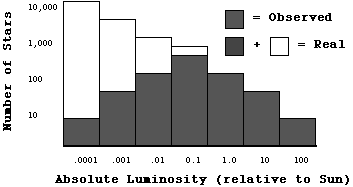
A useful statistic for studying the characteristics of a sample of stars is a bar graph known as the "luminosity function". This is simply a graph showing the number of stars in a sample within each given range of absolute luminosity. The luminosity function shown here is for a sample constructed by only selecting stars brighter than a certain apparent luminosity (which has problems, discussed in study guide question 54). The difference between our sample and a truly representative sample is shown in the diagram.

This difference between the observed sample and reality is called the Malmquist Bias (named after the Dutch astronomer who first explained it). Briefly explain why this difference between our observed sample and reality exists. (TQ #15)
(90)
In the above luminosity function, the number of stars in a representative sample seems to decrease as one looks for higher and higher luminosities. Use concepts from question 88 to explain why this happens. (TQ #16)

(91)
Referring again to the diagram from question 89, the same luminosity function holds even when you limit yourself to only looking at main sequence stars. Why are there so few main sequence stars out there with such high luminosities? Use concepts from question 69 to help respond to this question. (TQ #17)

(92)
Explain how the H-R diagram of a cluster evolves over time. How do these changes confirm our ideas about the relationship between stellar mass and main sequence lifetime?

(93)
What is the "turnoff point" on a cluster H-R diagram? Assuming we know the mass of a star at the turnoff point, how and why can we use that information to estimate the age of the cluster? For example, we know that the Sun has a main sequence lifetime of 10 billion years. Suppose a cluster H-R diagram has a turnoff point with a star of about 0.9 solar masses. Is this cluster younger or older than 10 billion years? Explain.

(94)
Explain what a planetary nebula is and why (generally) it occurs. Why is this fate suffered mainly only by low-mass stars instead of high mass stars?

(95)
Suppose we're looking at a planetary nebula as shown in figure 22-6 in your book (p 544). We can measure the angular size of the outer edge of the nebula with an angle-measuring device. We know from historical records the time the planetary nebula first went off (so we know the age of the expansion). We also can measure the cloud's velocity via Doppler shifts. Explain how we can use these three pieces of information to deduce the distance from Earth to this nebula. (Hint: Look into the Crab Nebula lab and also how we dealt with face-on binary systems). (TQ #18)

(96)
What is different about Iron fusion compared to the fusion of other, lighter elements? Why does the onset of iron fusion signal the end of the lifetime of even the most massive stars?

(97)
Virtually every atom of gold on the Earth (including in jewelry) was originated inside a supernova billions of years ago. Explain how we know this, and explain roughly how the gold got from inside the star to the Earth.

(98)
With a simple diagram and 2-3 sentences, briefly explain how a pulsar works. What distinguishes neutron stars from pulsars? In other words, why do some neutron stars appear to pulse as seen from Earth while others do not? You do not need to describe in any detail the physics behind the "jet" of radiation at the magnetic poles, just know that it is there (though it is similar in many respects to the physics that direct solar wind particles to points near the Earth's magnetic poles, generating aurorae at high northern and southern latitudes).

(99)
Given the definition of angular momentum (and given that it is conserved), why do neutron stars tend to rotate so quickly?

(100)
What causes nova explosions in binary star systems?

(101)
Define metal and metallicity. How and why does the metallicity of the ISM change over time?

(102)
Does the metallicity of a main sequence star change over time? Why or why not? How does the metallicity of an old main sequence star compare to the metallicity of a young main sequence star, and why would you expect them to be different?

(103)
How does the metallicity of a cluster of stars relate to the age of that cluster? How does it relate to the mass of a star at the turnoff point? Given the turnoff masses (or H-R diagrams), be able to state which cluster would probably have a higher metallicity in its main sequence stars and why.

(104)
How do colors of individual stars change over the course of the main sequence lifetimes? If you see a solitary blue star, what can you say with confidence about its age? If you see a solitary red star, what can you say with confidence about its age? Explain.

(105)
How and why do the colors of star clusters change over time? Would you expect a cluster with high metallicity to have a blue color or red color? Explain.

(106)
What is a black hole? How do we use the concept of escape velocity to define the boundary (event horizon) of a black hole?

(107)
Explain step-by-step how to use the P-L relation to find the distance to a star cluster or distant galaxy.

(108)
Be able to answer simple mathematical questions about the P-L relation, such as "Cepheids X and Y have the same apparent luminosity, but star X's period is twice as long as star Y's period. Assuming no interstellar corrections, which one is further away?" Be able to identify periods of Cepheids by looking at their light curves.

(109)
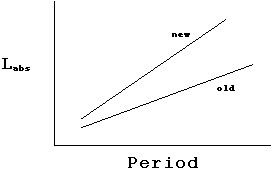
Suppose there is a problem with the calibration of our Cepheid P-L relationship. New parallax observations have shown that the old absolute luminosity estimates were too low for a sample of Cepheids. The new and correct relationship is shown below.

Suppose we determined the distance to a globular cluster using the old P-L relation and the method described in 107. Is our new distance larger or smaller than our old distance? Systematic errors like this can affect not only distance estimates but also age estimates for clusters, a topic of critical importance in cosmology as we will see later. (TQ #19)

(110)
Explain how we use observations of Hydrogen's 21 cm emission line to map the motions of the disk of our galaxy.

(111)
Given the equation of orbital velocity, be able to explain the basic shape of the Keplerian rotation curve. Also, be able to explain the shape of the solid-body rotation curve.

(112)
Explain why the extended nature of the galaxy's mass leads us to expect the rotation curve of the galaxy will have a slightly different shape than Keplerian (orbital velocities slightly higher).

(113)
Explain how the flat rotation curve of our galaxy leads us to believe that the galaxy has a very large amount of dark matter, much more than the visible matter in stars, gas and dust that we can easily see.

(114)
Suppose the amount of dark matter in the Milky Way Galaxy were 10 times more than it is currently. Would it be possible in such a case to get a *rising* rotation curve (more similar to a solid-body curve)? Explain why or why not.

(115)
Explain why the disk of our galaxy contains virtually all of the new stars that are forming in the galaxy, and also explain why the disk (especially the spiral arms) tends to have a blue color.

(116)
Explain what a density wave is and how it contributes to star formation in the spiral arms. Even though the spiral arms contain a few percent more mass than the rest of the disk, they put out most of the light and are very easily visible compared to the rest of the disk. Explain why.

(117)
How do we know that there is a supermassive black hole at the center of our galaxy?

(118)
List the primary functions of a telescope, and explain how each one is related to the aperture diameter of the telescope (you will be given the resolution equation on the exam). Just for your own background information, you can find out a lot more about buying telescopes from Sky and Telescope's website, particularly http://www.skypub.com/tips/telescopes/buying.html and http://www.skypub.com/tips/telescopes/choosing.html.

(119)
Look on the web for information about the Next Generation Space Telescope (NGST), the planned successor to the Hubble Space Telescope, and answer the following: Why is it useful to have telescopes above the Earth's atmosphere when we have such advanced equipment on the ground? What wavelengths of light will the NGST observe, and why are these wavelengths important? What are two major things we hope to learn about with the NGST, and why will the NGST be better equipped to answer these questions than other telescopes? (TQ #20)

(120)
Explain how Earth's atmospheric effects result in large aperture telescopes on the Earth having relatively poor resolution. In a couple of sentences, summarize how adaptive optics compensates for the effects of the Earth's atmosphere.

(121)
Explain why it is useful to observe parts of the galaxy (such as the nucleus) at wavelengths besides optical, like radio wavelengths. Explain how and why radio telescopes are at a resolution disadvantage relative to optical telescopes, even though radio telescopes have much larger aperture diameters.

(122)
Explain qualitatively how interferometry works to improve the resolution of radio telescopes. Why isn't interferometry practical for most optical telescopes yet?

(123)
Aside from resolution issues, what is another good reason for observing above the Earth's atmosphere? Why would Astronomers want to observe in regions of the spectrum other than the optical (aside from the scattering problem mentioned for optical vs radio telescopes in 121).

(124)
Read through the information from NASA's Infrared Processing and Analysis Center (IPAC) web site at http://www.ipac.caltech.edu/Outreach/Edu/ and answer the following questions: Describe how William Herschel discovered infrared light. What two gases are largely responsible for the absorption of infrared light in our atmosphere (making it difficult to observe infrared light coming from stars, nebulae and galaxies from the Earth's surface)? Do more stars tend to show up in visible sky photographs or near-infrared photographs? What two kinds of stars tend to show up in near-infrared photos? What shows up most prominently in far-infrared photos and why? (TQ #21)

(125)
Explain how Hubble used Cepheid variables to prove that "Galactic Nebulae" were actually other galaxies like our own located at very large distances from the Earth (much larger than the size of our own galaxy).

(126)
What is Hubble's Law? How can it be used to determine the distance to a galaxy if the redshift of that galaxy is known?

(127)
If you tried to plot a "Hubble's Law" of radial velocity vs distance from Earth for stars in our own galaxy, what would it look like? Explain.

(128)
Explain the merger hypothesis. List the general properties of spirals vs ellipticals and discuss how these are consistent with the merger hypothesis.

(129)
Elliptical galaxies tend to be found near the centers of galaxy clusters. Explain how/why this fact is consistent with the merger hypothesis.

(130)
The star formation history of ellipticals and spirals is very different (as shown in the text, ellipticals form all their stars in a burst near the time of formation whereas spirals tend to have continuous star formation). Explain how this observation is consistent with the merger hypothesis.

(131)
Explain how spiral galaxies form. In particular, explain why they tend to have a disk shape and why all of the gas and dust tends to congregate in the disk while many stars and star clusters remain in the halo.

(132)
Explain why the Cepheid P-L relation as a method of distance determination is distance limited. In other words, why doesn't it work beyond a certain distance from the Earth?

(133)
Explain what the Tully-Fisher (TF) relation is. Describe briefly how one would use the TF relation to find the distance to an edge-on galaxy.

(134)
Explain how the inclination angle can affect our distance estimate. For example, suppose we fail to take the inclination angle of a galaxy into account so that the radial velocity we measure for that galaxy's rotation is smaller than the true rotation speed. Will we underestimate or overestimate the distance to that galaxy? Explain.

(135)
Explain why the TF relation is distance limited. In other words, why doesn't it work as a distance determination technique beyond a certain distance from the Earth?

(136)
Discuss briefly how the standard candle method of distance determination works. Explain why individual stars are not useful as standard candles for finding distances to galaxies that are very far away.

(137)
Although star clusters and galaxies have varying absolute luminosities, it is possible to use them as standard candles if one is careful about selecting them. How is it possible to pick two star clusters or two galaxies and have some notion that they have similar absolute luminosities? What is the reasoning behind this technique? Why doesn't this work well for distance determination in each case?

(138)
Why do supernovae make such great standard candles? Why are they so difficult to observe (so much so that they have only been observed in large numbers in the past 10 years or so)? Not all supernovae have the same absolute luminosity. Explain why some supernovae (those whose parent star is a white dwarf) tend to have uniform absolute luminosities while others (whose parent star is just some star with greater than six solar masses) do not.

(139)
One possible candidate for the dark matter in our galaxy is very faint stars, about 1/10th the mass of the Sun, stars that aren't ordinarily visible to telescopes on the Earth. How do we know that these probably do not account for the dark matter?

(140)
Explain gravitational lensing, or the effect in which the presence of mass alters the path of a beam of light.

(141)
Read the following article entitled "The Ghostliest Galaxies" at http://www.sciam.com/specialissues/0398cosmos/0398bothun.html and answer the following: How did astronomers detect these Low Surface Brightness (LSB) galaxies, since ordinary starlight from them is not bright enough for conventional techniques? How do the numbers of LSB galaxies compare to the number of ordinary galaxies, and why do we think there might be even more that we can't detect? Finally, how do we know that these galaxies haven't evolved very much since the beginning of the Universe? (TQ #22)

(142)
Explain how microlensing works. What happens to the appearance of a star during a microlensing event? How does this variation in a star differ from other kinds of variations (eclipsing binaries, Cepheid variables)?

(143)
How do we use microlensing to estimate the amount of dark matter in the galaxy consists of planet-sized objects (MACHOs)? Do planets constitute any of the dark matter? How do we know?

(144)
Research the following web site from Sky and Telescope, http://www.skypub.com/news/news.shtml#halodwarfs, and answer the following questions about dark matter: According to Oppenheimer and his colleagues, what sort of object may account for a large fraction of the dark matter in our galactic halo? What are two reasons these objects have been missed before by ordinary surveys? Explain why these relatively cool objects have blue colors. (TQ #23)

(145)
Be able to plot a graph of a car race at various times as we did in lecture given some basic data. Given a graph of a car race, be able to find the slope of the graph and the age of the race.

(146)
What is the Hubble constant? A Hubble constant of 70 implies that the age of the Universe is 10 billion years. What if the Hubble constant were recalculated to be 50...how would our estimate of the age of the Universe change (younger or older)? Explain.

(147)
What would Hubble's Law look like if the Universe were not expanding? What would it look like if the Universe were contracting? Draw your best guess graphs and explain them. (TQ #24)

(148)
Explain why the Hubble relation, which indicates that all galaxies seem to be moving away from our location, is not a violation of Copernican Principle (which says there shouldn't be anything unusual or special about our location ... in other words, we shouldn't be at the center of anything).

(149)
What prediction does the Hubble relation make about the ages of the oldest stars in the Universe? How do we estimate the ages of things like globular clusters (may want to refer back to question 93)?

(150)
How do we know whether or not the Universe will expand forever or at some point turn around and collapse? How do we try to answer this question? How and why is the study of dark matter important?

(151)
What is the critical density? How and why does the relationship between the density of matter in the Universe and the critical density determine the ultimate fate of the Universe (whether it will expand forever or collapse)?

(152)
Assuming gravity is slowing down the expansion of the Universe, how would you expect Hubble's Law to deviate from a straight line in the presence of a little bit of gravity or a lot of gravity? Explain why the graph changes shape, using the concept of lookback time.

(153)
How does the metallicity of a galaxy change over time? Does it increase or decrease? Why? If you were to draw a graph of galaxy metallicity vs distance from Earth, taking lookback time into account, how would it look? Would galaxy metallicity seem to increase at greater distances? Decrease? Or remain the same? Explain. (TQ #25)

(154)
Explain how current observations of galaxy radial velocities and distances compare to the expectations of Hubble's Law under the influence of gravity. Explain why these observations lead us to believe that the Universe is accelerating away from us in all directions.

(155)
Explain what the Cosmological Constant is (and why it is relevant in light of recent observations referenced in 154). Why did Einstein originally introduce the idea of a Cosmological Constant? Why was it later abandoned?

(156)
Why can't we look at the way back in time to the moment of the Big Bang? Explain where the Microwave Background Radiation (MBR) comes from.

(157)
Do some research on the World Wide Web regarding the "Anthropic Principle" and define one version of it (Weak, Strong, etc) in your own words. Give an example of an "Anthropic Coincidence", the kind of thing that leads people to propose the Anthropic Principle in the first place. This is the last thought question for the course. (TQ #26)

(158)
Explain why the current structure of the Universe leads Astronomers to believe that the MBR must have a lumpy nature, with measurable fluctuations.

(159)
Explain how the existence of the MBR, the shape of its spectrum and its fluctuations are seen as convincing evidence of the Big Bang theory. What is different about this evidence in favor of the Big Bang compared to Hubble's original observations? Why are the observations of the MBR really seen as the key to confirming the Big Bang instead of just relying on Hubble's Law?

(160)
Although most Astronomers are confident that the Big Bang theory is likely the correct model to explain the observational facts we studied, this theory still has some minor but important inconsistencies. Why are Astronomers so confident of the Big Bang theory and skeptical about inconsistencies in the Big Bang?