2) A graph of the Cepheid Period-Luminosity relation is shown below. Also shown are the light curves for two Cepheid variable stars (Alpha and Beta). The absolute luminosity axes for the two Cepheid light curves do not necessarily have the same scale or zero point. They are simply drawn to look similar for convenience.
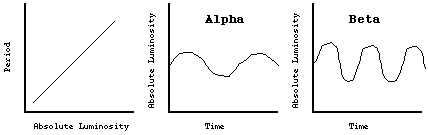
- a) (10 pts) If both Alpha and Beta are at the same distance from Earth, which one has a higher average apparent luminosity? Explain your reasoning.
- b) (4 pts) The Cepheid P-L relationship is not usable for stars at very large distances in other galaxies. Explain briefly why not.
3) One of the most useful ways to determine the distance to some galaxies is the standard candle technique, but this technique has some problems if not done with care.
- a) (7 pts) Explain briefly how the standard candle method works, then explain why supernova explosions are much more desirable to use as standard candles compared to random galaxies.
- b) (7 pts) One side effect of supernova explosions is the release (in theory) of gravitational waves. Briefly explain how scientists are proposing to detect these on Earth (explain the mechanism used, how it works).
4) One way to improve on the standard candle technique using galaxies is to choose which galaxy one uses as a standard candle carefully.
- a) (7 pts) Explain why you could get a much more reliable standard candle distance by choosing the brightest galaxy in a cluster as your standard candle.
- b) (7 pts) Some of the faintest galaxies in clusters are known as Low Surface Brightness (LSB) galaxies. What evidence leads us to believe that LSB galaxies might be far more numerous than ordinary galaxies?
5) To study the motion of our galaxy, we observe the 21-cm transition in Hydrogen atoms, which is a well-studied example of a forbidden line.
- a) (6 pts) Explain why forbidden line transitions only tend to occur in very low density gas? As part of your answer, explain how these transitions are different from ordinary electron transitions between energy levels in atoms.
b) (8 pts) Study of the motions of gas in our galaxy tells us that the rotation velocity of the galaxy is constant (or ³flat²) even as one moves further and further from the center. This is seen as evidence for a huge amount of dark matter in the galaxy. Explain why the flat rotation curve is seen as evidence for the existence of dark matter.
6) Explain how we use the Tully-Fisher (TF) relation (the correlation between rotation velocity and absolute luminosity for spiral galaxies) to determine the distance to spiral galaxies. ALSO explain why the TF relation is distance-limited.
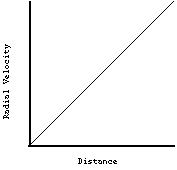
7) For this particular problem, you may assume that there is no acceleration or deceleration of the expansion of the Universe due to gravity or any kind of cosmological constant (just trying to keep it simple). Today, when the Universe has an age of about 10 billion years, we can draw a Hubble relation as below. Suppose Astronomers had been alive 5 billion years ago and drawn a Hubble diagram based on the data they observed at that time. Would it look different? If so, show on the diagram how it would change. If it wouldnıt look different, just write ³no change² on the diagram. In either case, justify your answer in 2-3 sentences.
8) Two possible candidates that may constitute the dark matter that makes up 90% of the mass in our galaxy are MACHOs and massive black holes, both presumably detectable not by their own light but by the effects they have on the light from more distant stars.
- a) (8 pts) Briefly explain how we detect MACHOs based on variations in stellar brightness. Also, explain how and why MACHO-induced brightness variations are different from other kinds of brightness variations (like Cepheid variable fluctuations or eclipsing binaries).
- b) (6 pts) We could in theory detect massive black holes using the same technique as that used to detect MACHOs, but it is far less practical. Explain why.